Three Philosophical Poets by George Santayana
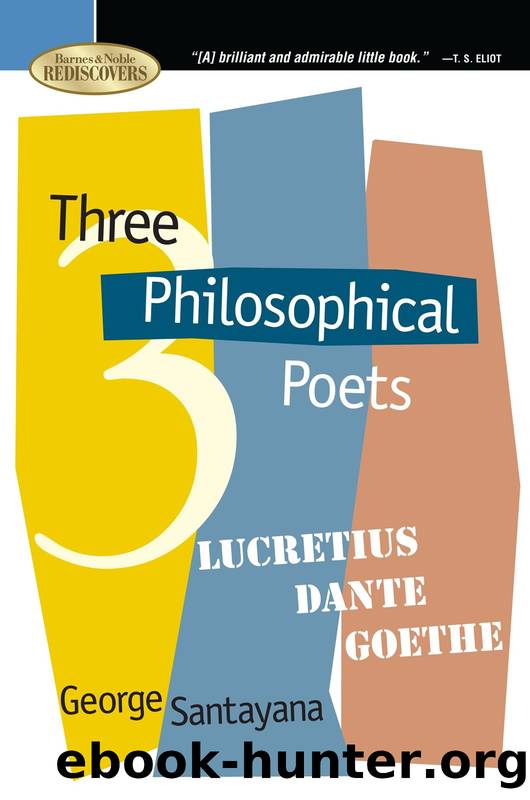
Author:George Santayana [Santayana, George]
Language: eng
Format: epub
ISBN: 9781435142237
Publisher: Fall River Press
PART IV
Goetheâs Faust
IV
GOETHEâS FAUST
IN APPROACHING THE THIRD OF OUR PHILOSOPHICAL POETS, there is a scruple that may cross the mind. Lucretius was undoubtedly a philosophical poet; his whole poem is devoted to expounding and defending a system of philosophy. In Dante the case is almost as plain. The Divine Comedy is a moral and personal fable; yet not only are many passages explicitly philosophical, but the whole is inspired and controlled by the most definite of religious systems and of moral codes. Dante, too, is unmistakably a philosophical poet. But was Goethe a philosopher? And is Faust a philosophical poem?
If we say so, it must be by giving a certain latitude to our terms. Goethe was the wisest of mankind; too wise, perhaps, to be a philosopher in the technical sense, or to try to harness this wild world in a brain-spun terminology. It is true that he was all his life a follower of Spinoza, and that he may be termed, without hesitation, a naturalist in philosophy and a pantheist. His adherence to the general attitude of Spinoza, however, did not exclude a great plasticity and freedom in his own views, even on the most fundamental points. Thus Goethe did not admit the mechanical interpretation of nature advocated by Spinoza. He also assigned, at least to privileged souls, like his own, a more personal sort of immortality than Spinoza allowed. Moreover, he harboured a generous sympathy with the dramatic explanations of nature and history current in the Germany of his day. Yet such transcendental idealism, making the world the expression of a spiritual endeavour, was a total reversal of that conviction, so profound in Spinoza, that all moral energies are resident in particular creatures, themselves sparks in an absolutely infinite and purposeless world. In a word, Goethe was not a systematic philosopher. His feeling for the march of things and for the significance of great personages and great ideas was indeed philosophical, although more romantic than scientific. His thoughts upon life were fresh and miscellaneous. They voiced the genius and learning of his age. They did not express a firm personal attitude, radical and unified, and transmissible to other times and persons. For philosophers, after all, have this advantage over men of letters, that their minds, being more organic, can more easily propagate themselves. They scatter less influence, but more seeds.
If from Goethe we turn to Faustâand it is as the author of Faust only that we shall consider himâthe situation is not less ambiguous. In the play, as the young Goethe first wrote it, philosophy appeared in the first line,âHab nun ach die Philosophey; but it appeared there, and throughout the piece, merely as a human experience, a passion or an illusion, a fund of images or an ambitious art. Later, it is true, under the spell of fashion and of Schiller, Goethe surrounded his original scenes with others, like the prologue in heaven, or the apotheosis of Faust, in which a philosophy of life was indicated; namely, that he who strives strays, yet in that straying finds his salvation.
Download
This site does not store any files on its server. We only index and link to content provided by other sites. Please contact the content providers to delete copyright contents if any and email us, we'll remove relevant links or contents immediately.
The remains of the day by Kazuo Ishiguro(9081)
Tools of Titans by Timothy Ferriss(8490)
Giovanni's Room by James Baldwin(7432)
The Black Swan by Nassim Nicholas Taleb(7193)
Inner Engineering: A Yogi's Guide to Joy by Sadhguru(6835)
The Way of Zen by Alan W. Watts(6669)
The Power of Now: A Guide to Spiritual Enlightenment by Eckhart Tolle(5854)
Asking the Right Questions: A Guide to Critical Thinking by M. Neil Browne & Stuart M. Keeley(5831)
The Six Wives Of Henry VIII (WOMEN IN HISTORY) by Fraser Antonia(5557)
Astrophysics for People in a Hurry by Neil DeGrasse Tyson(5224)
Housekeeping by Marilynne Robinson(4502)
Double Down (Diary of a Wimpy Kid Book 11) by Jeff Kinney(4332)
12 Rules for Life by Jordan B. Peterson(4331)
Ikigai by Héctor García & Francesc Miralles(4310)
The Ethical Slut by Janet W. Hardy(4307)
Skin in the Game by Nassim Nicholas Taleb(4305)
The Art of Happiness by The Dalai Lama(4167)
Skin in the Game: Hidden Asymmetries in Daily Life by Nassim Nicholas Taleb(4050)
Walking by Henry David Thoreau(3998)
